
Audience measurement system components



1d to 2d translation
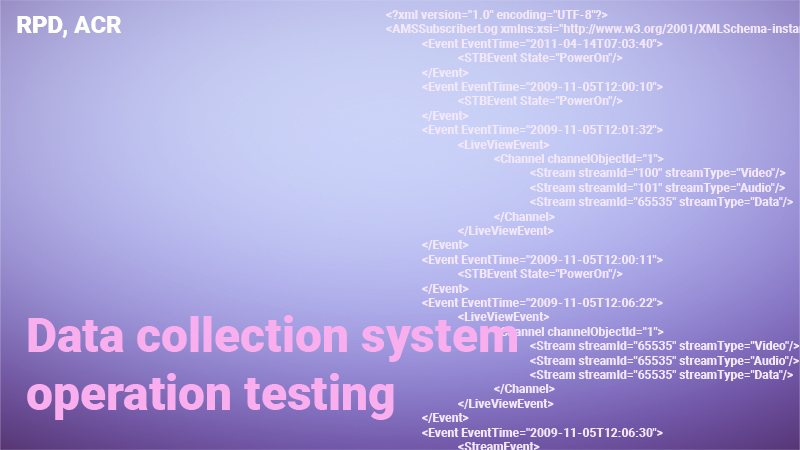
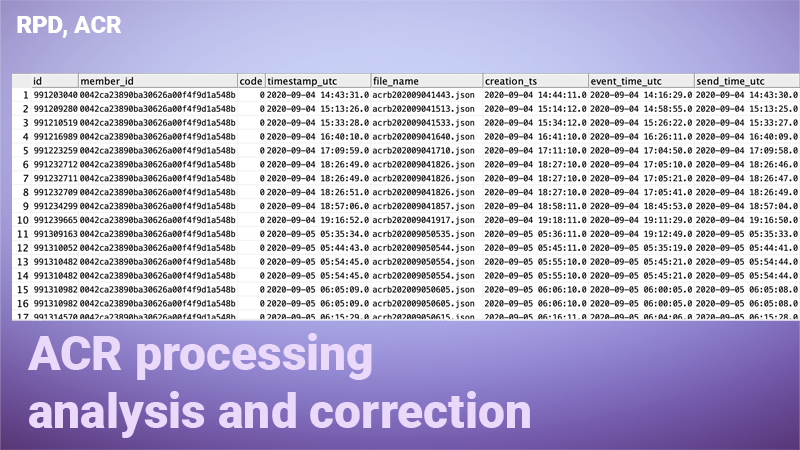
Most audience measurement systems reliant on ACR (automated content recognition) and many others return one-dimensional, point-in-time data (timestamp, panelist_identifier, content_or_channel). These must be processed into two-dimensional respondent-level records (timestamp_start, timestamp_end, panelist_identifier, content_or_channel). This is far from a straightforward process:
- Time should be managed such that fingerprint sets arrive at the reference database before they arrive from devices to the field-data database, so that the viewing does not appear to have occurred before airtime. This task is complicated by the wide range of latencies between signal transmission and delivery through various means (the range is at least one minute in a medium-sized country).
- All plays of the content on all channels during the configured timeshifting interval will be matched. The correct one should be selected and the others discarded.
- Brief interruptions in measurement, typical of many smartphone models, must be bridged. How long to bridge is a judgment call, balancing accurate presentation of longer viewing events against the possibility that the viewer left the channel or content during the bridged interval.
- Occasionally the channel actually being viewed will not be matched for one or two measurements when in fact it was viewed. These intervals must be bridged, again in a balancing of recognition of one human behaviour (channel zapping or grazing) at the expense of another (longer-period viewing).
- The confidence score reported by the ACR matching system should be interpreted so as to filter real viewing from noise.
- Changes in timeshifting (the time between airtime and viewing) during a viewing session to the same content or channel, indicative of pause or trickplay, must be responded to (beyond a minimal threshold, by separation into two viewing events).
- Advertising creative must be recognised as such and preserved for separate reporting.
Streaming, timeshifting and DVRs
Timeshifting is the viewing of video programming or listening to audio programming after it has aired. It can be done through on-demand services, catch-up services integrated into a pay-TV EPG (electronic programme guide), a timeshifted channel, or a physical or cloud DVR. In most cases, the content is streamed to the TV set or other device through which it is viewed or listened to.
VOD (video on demand) or AOD (audio on demand) streaming has become the main method of timeshifting. A very large part of all programme content is available only through streaming after it airs on television, and many programmes never air on television but are released exclusively on streaming. Streaming services also carry many theatrical films and exclusive programming that they produce. Streaming services charge a subscription fee, are funded by advertising (which usually cannot be skipped), or both. Some streaming services have multiple tiers from mostly or entirely ad-funded ones to ad-free subscription-based ones.
Most television audience measurement services do not capture VOD use either through their panels (which are large enough to capture viewing of at least the most popular programming) or by integration with the VOD service operators (many of which resist independent measurement and refuse to share their server-side data). In cases in which the measurement company does have access to VOD service server-side data, fusing it to panel data to impute coviewing (viewers per viewing household, VPVH), personas and demographics presents a substantial challenge to which there are no broadly accepted solutions.
DVR (digital video recorder, sometimes termed PVR, personal video recorder) is a time-delay recording technology that records viewing, either by explicit decision of the viewer or in accordance with a set of rules (a single broadcast, a “season ticket” to record an entire series for “binge watching” at season’s end, explicit genre rules, or in some systems, individual “if you liked this, you’ll probably like that” suggestions). Largely replaced by on-demand viewing, DVRs (today usually implemented in the provider’s cloud) are still relevant because they add trickplay capability (pause, rewind, fast-forward, speed multiples) to both realtime and timeshifted viewing (they buffer 90&endash;120 minutes of the currently tuned channel to enable these functions in realtime). They permit catching up to a live broadcast without ads or boring segments, and fast-forwarding through, or on some models entirely skipping, advertising breaks.
DVR viewing is not present in RPD data unless the data collection system is deliberately designed to include it.
OTT (over-the-top) refers to content viewed bypassing conventional television, especially on devices other than big-screen TV sets (broadband-connected computers and smartphones (from which it can optionally be streamed to TV monitors using products like Google Chromecast, Amazon Fire TV or Roku), on smart TVs or on broadband-connected gaming platforms). Because streaming content can now be viewed regardless of device, the term “OTT” is falling out of use, subsumed by “VOD” or “streaming”.
Pay-TV operators fear being reduced to eventual irrelevance if exclusive sports content becomes unmoored from the need to subscribe to their own services, and although this threshold is far from having been universally reached, the trend is definitely in this direction.
Deduplicated and incremental reach and incremental impressions per platform
At the turn of the millenium, advertisers often could reach all or most of their target audiences with a simple conventional TV (terrestrial and pay-TV) buy. This is no longer true. In most Western countries, people under age 50 still watch conventional TV but in much smaller numbers, having moved to on-demand viewing. This means advertisers must buy both conventional TV and streaming/VOD. They want to know how much a specific streaming/VOD buy extends their reach, and how it affects the count of impressions per viewer, which may be so high as to cause annoyance or so low as to be insufficient for the message to be effective. The advertisers can cap impressions per platform in programmatic buys, but they need this information to know how to use this capability. Thus "Deduplicated reach" (and incremental impressions) has become the holy grail of advertisers; in most Western countries, it remains elusive.
Conventional audience measurement providers struggle to measure streaming/VOD platforms: their technical equipment often cannot measure them, and even if it did, their panel sizes would be able to detect only the most popular programming on these platforms. Major streaming/VOD platforms such as Netflix and Amazon Prime Video have long tried to avoid independent measurement; they refused to sell access to their own and forced connected-TV manufacturers to agree not to measure them as the cost of being permitted to preinstall the platforms’ must-have apps. To some extent, these platforms still behave this way, but they are gradually realising that independent measurement is good for their ad sales.
But the use of more than one data source, as in any audience measurement system that integrates more than one census-level source (not just VOD but also connected TVs and pay-TV systems), or a census-level source and a panel, or two panels (as in The Netherlands), this raises another problem: how to remove duplicates from one of the two datasets (the panel and the server-side, census-level data from the platform).
There are multiple solutions to this problem, varying in complexity and both capital and operational cost. A simple match on the viewer’s current IP address is key, but in the samples of the large global TAM providers there will often be router-meters, which require professional installation and are labour-intensive to keep correctly configured, both on the LAN and the WAN sides.
Intab definition, loss detection and timely reporting
Intab
The intab (sometimes termed the net daily reporting sample or usable sample) is the daily cooperating part of the sample, on which the ratings published for that day are based. This requires detecting measurement devices with data loss on that day and excluding them from the intab. If this is impossible (as it is when mobile devices are used for measurement, which are often unpowered part of the day), special algorithms must be used to ensure accurate reporting.
Cooperation
Cooperation, in the TAM meter and RPD contexts, means that:
- a set is available for measurement (capable of recording and reporting viewing data) during the reporting day, even if it is not used to watch; and
- that the set, even if it returned viewing data, was so available throughout the entire day—and no data from it were lost.
Why this standard is important
- If an STB is admitted into the intab whose data for that day was even partially lost, an underestimate results.
- However, when an STB is available for measurement all day and is simply not used for viewing, it must be included in the intab. If it is not, the ratings will be overestimated.
Timely reporting
It is highly desirable that backhaul of data from the measurement devices be arranged such that overnight reporting be based on the maximum possible portion of devices that ultimately return data. Restatement of ratings for the same timeshifting bucket (as in the practice of issuing a preliminary release followed by a final one) tends to reduce market confidence in the measurement.
Census-level data
Census-level data are viewing and other related measurement data collected by software on streaming services, connected TVs, pay-TV STBs (set-top boxes), digital terrestrial multiplex receivers/decoders (used in many countries outside the U.S.), or DVRs and sent by Internet to the operator. Usually, unlike in TAM, no opt-in or sample recruitment is needed as the data collection is authorised in the user’s or subscriber’s user agreement. Typical sample sizes are far larger than in classical TAM, often reaching six digits rather than four or five for TAM. The costs per device are much lower than in TAM and often trivial. Costs of processing the data can also be controlled much better than in a dedicated operation, although a more complex technological environment would result in higher costs.
However, census-level data are of devices or households rather than individual viewers; a viewing event does not disclose how many people viewed or indeed whether any at all viewed the TV set (or, usually, even whether the TV set was on). Nor are there demographics other than the socioeconomic class derived from the service address. To personalise the data, it must be fused with panel data.
Sample management and balancing (weighting)
Sample management is the selection and tracking of households, devices and individuals in the sample—the group of households or devices capable of returning measurement data or, less commonly, a selected subgroup of these.
This area is one in which classical TAM and census-level data providers’ (VOD/AOD services, pay-TV operators, connected-TV manufacturers, streaming dongle makers, DVR companies) practices differ greatly. TAM providers can afford only a small sample because of the high cost of recruiting and metering each household. Furthermore, because they quite consciously do not control their samples by income, education or occupation or even geography at a scale granular enough not to be overly diverse, but only by large geographic area, age, and gender (a practice that leaves a Boston corporate lawyer and a Chelsea, Massachusetts bus driver who never finished high school looking exactly identical), they overly rely on the randomness of the sample household selection as a panacea for those failings—which it is not, at those predetermined low sample sizes. The TAM provider will make several efforts to recruit the randomly selected household, and if it fails, will turn their attention to its nearest neighbour. Copious empirical evidence has shown that a different sample recruited in this manner to the same composition by the few tracked attributes, after a year to shake out early participants (which have an increased tendency to leave), can return completely different results, favouring different channels, than the preexisting sample, and that this process can be repeated endlessly with the same outcome.
The use of census-level data, on the other hand, is founded on the strategic advantage of much larger samples due to the default availability of measurement collection software on devices. Thus, census-level data sources usually accept all the sample they can get.
Balancing (weighting)
Like any audience measurement provider, we balance our panel sample using a scientifically accepted multivariate algorithm that avoids the need for the sample distribution to be exactly that of the subscriber universe as well as the operational difficulty of populating numerous microcells of various attributes (used by some very simple radio ratings services, for example, but not practical for multichannel television). Our implementation of such an algorithm runs daily. To include census-level data in balancing, it must be personalised and equipped with demographics through fusion.
Channel management
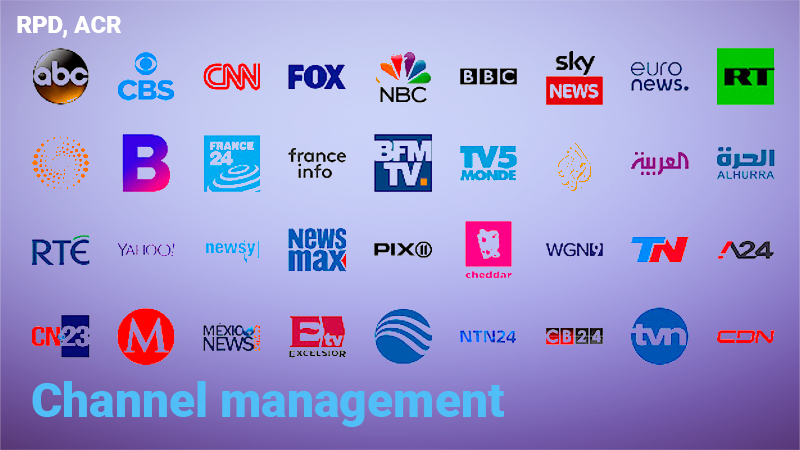
Channels must be described adequately and their viewing schedules identified. In some pay-TV systems, this task is extremely complex.
Some TAM providers obligate channel operators to encode their channels and programmes especially for measurement, a time-consuming and costly process with which many don’t comply, becoming unmeasurable. Others use alternative means of automated identification, also with poor reliability.
RPD systems use the pay-TV operator’s channel identification, which can range from simple and reliable (when the channel lineup rarely changes and a stable, standard channel identifier such as the DVB triad is used) to incomplete and maddeningly complex (entirely lacking a stable identifier and other essential metadata, such as the channel and feed name). Furthermore, multiple instances of the same content channel appearing on the same or multiple included sources (such as different pay-TV systems or a given operator’s CATV and IPTV systems may vary.
We successfully provide channel management even in these most complex environments.
Schedule management
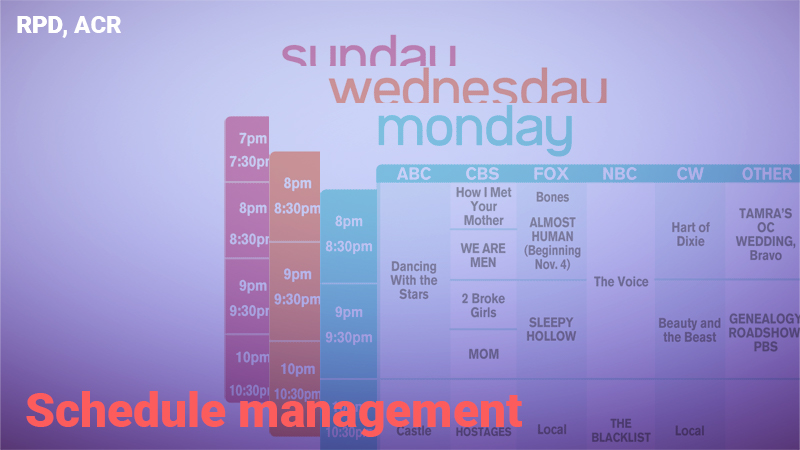
Schedule management is the processing of detailed descriptions of broadcasts at particular times in the schedules of channels, and their linking to the channels themselves. Although this task sounds simple, in practice it often isn’t. First, the schedules must be related to the channel and to its viewing (sometimes on different identifiers), so all the difficulties of channel management are present.
A second problem is identification of the series or special and the episode within a series; these are often inconsistent or incomplete, while programme and episode titles are even less standardised. Whether a sports game is live, a recorded première or a repeat dramatically affects its ratings but such designation is rarely in the schedule and then has to be supplied in processing. Genre data, and for movies, directors’ and actors’ names, all useful in searches and filtered reports, are often also incomplete, inconsistent or absent.
Overruns of live events, such as sports games, are usually noted for the benefit of DVR users, but not always, and deviations from schedules due to breaking news are unexpected and are almost never corrected. Because there is no standard practice for dealing with an overrun or deviation (the scheduled program might be joined in progress, the entire announced schedule might be postponed, or individual broadcasts deleted and rescheduled), such problems might not be capable of easy correction, to the consternation of clients. Indeed, because the ratings service is usually the only part of a pay-TV operation that cares about the schedule after a broadcast ends, there might not even be reliable access to such postbroadcast corrections as are made.
Timezone management
The scheduling of TV programming of any large broadcast company must cope with different time zones. For example, the U.S. and Canada have six time zones, Mexico has four, and South America has three, with further variation in the observance (or not) of daylight savings time and its start and end. Broadcast networks and pay-TV channels use multiple feeds, identical but offset from each other by several hours, to show programming at the correct time in each time zone. This is further complicated by network affiliates’ and pay-TV operators’ decisions (which may affect some or all of them in the market) in some areas to deviate from the schedules intended for them by using different feeds, and by the tendency of pay-TV operators to offer multiple feeds of the same channel, especially for premium channels. Furthermore, live entertainment, breaking news and some scheduled news events, and much sports programming are carried live regardless of timezone, disrupting the rest of the same feeds’ schedules.
The need to manage the resulting complexity varies by pay-TV and channel operator but generally tends to increase along with distribution capacity, which creates an incentive for pay-TV operators to add features such as regional broadcasting and for channel operators to add more geographically targeted feeds (whereupon offering them in all timezones is a free way of increasing customer satisfaction, which almost all channel operators take up).
We have successfully dealt with this daunting issue in some of the most challenging regions of the world, including, in several settings, in the U.S., in which single national ratings are expected for each network broadcast, which may be aired by its hundreds of affiliated local stations at different times—and occasionally not at all.
Capping of tuning-without-viewing
Tuning-without-viewing is a problem for both census-level systems and conventional TAM (television audience measurement). Some viewers leave the TV at full power while not paying attention, leaving the room or even going to sleep or to work. Different TAM systems try to limit it to differing extents and using differing approaches.
This problem is of much greater concern in RPD measurement because data on the monitor’s state (on/off/standby) are not available. Various methods are used to estimate the probability that part of a long period of viewing of the same channel is tuning-without-viewing. Unfortunately with some exceptions in individual countries, none of the large global TAM providers that also undertake census-level data processing publish their algorithms in even general terms, instead treating them as industrial secrets and making comparison between them almost impossible.
Controversially, some JICs (joint industry committees, which in most countries award the currency TAM contracts) have imposed strict capping requirements on all data sources when the viewer does not reconfirm his or her presence in response to a people-meter prompt, or a mobile phone used for measurement is immobile more than briefly, for both conventional TV and streaming. Such practices have the potential to alter the measurable audience dramatically, and thus to wreak havoc in the advertising market, or benefit some stakeholders (unsurprisingly, those with greater representation on the JIC) at the expense of others. This is especially inexcusable in light of the copious evidence of people-meter household members’ undetectable, unenforceable partial noncompliance with confirmation prompts, and separately research that identifies the narrow percentage of viewing sessions when the viewer was not colocated with his or her smartphone, permitting tuning-without-viewing detected by smartphone-based apps such as ours to be modelled.
The forthcoming WiFi standard 802.11bf (backwards compatible with WiFi 6 and later) offers the possibility of WLAN sensing of a person in the room. This, in combination with mobile device-based measurement, may provide the necessary evidence for the market to be confident that most tuning-without-viewing is thus eliminated.
VOD
VOD (video-on-demand) is a service that permits playback of programs entirely outside the context of broadcast schedules, although much VOD content does come from that which was broadcast. VOD can also include programs that no-one is planning to broadcast, greatly expanding the variety of available content.
Most VOD viewing is to standalone services such as Netflix or Amazon Prime Video, but pay-TV services also have their own VOD. In both cases, a broadband connection is typically required (some older systems do not require Internet connectivity). While easy to provide in a cable system, it requires separate provision of connectivity, often by the subscriber, in a DBS (direct-broadcast satellite) setup. With broadband, a larger selection can be offered. A DVR is not required, but if it exists, the delay before playback start can be shortened to trivial using file-based push technology, the quality of the playback improved, and the IP network decongested by offloading the playback stream.
There are several types of VOD:
- Catch-up TV, typically free to subscribers, enables viewers to watch programs hours or even a week or two after the original television broadcast. The EPG (electronic program guide) rolls backwards to provide an interface additional to the VOD thematic hierarchy.
- Subscription VOD (SVOD) is a model where subscribers are charged a monthly fee to access unlimited programmers. Some or all of the content may be available without additional charges to subscribers to specific plans.
- Advertising video on demand (AVOD) allows advertisers to reach people who watch shows using VOD and are less exposed to real time advertising messages. Viewers benefit by being able to watch the content without paying subscription fees.
- In transactional VOD (TVOD), the customer pays for each individual program. TVOD has two variants: electronic sell-through (EST), by which customers can permanently access a purchased program; and download-to-rent (DTR), in which customers can access the content for a limited time upon renting it.
- Near video on demand (NVOD) is essentially pay-per-view (PPV) with frequent starts of the same program. Except high-value events, especially in sports, PPV is disappearing in favor of the more capable and less wasteful VOD.
- Push video on demand (PVOD) uses several channels, invisible to the viewer, to preposition a small VOD library on part of the DVR hard disk. It is useful where there is no broadband downlink, such as on cable systems without broadband or on DBS for STBs not connected to broadband.
VOD services have measurement on the server side, but like any other census-level data source, are unable to tell whether anyone is watching or how many people, nor do they have demographics beyond an often vague geographic indication that is relatable to socioeconomic class (SVOD and pay-TV system operators have the service address, but AVOD systems have only the IP address, which correlates to a vague and ever-shifting area which is almost impossible to track with precision and, even if tracked, may cover multiple socioeconomic classes). This problem can be solved by fusion with panel data.
VOD can be integrated into an RPD audience measurement system. For this, the content (programme) identifier has to match that used in realtime and DVR viewing. This is not true in some pay-TV systems, but can be made true with some effort. The advantage of measuring VOD and realtime viewing in combination, also including the provider’s OTT service, is to inform the pay-TV operator of its long-tail cost, revenue and ROI (return on investment).
What not to do
Contrary to an understandable superficial impression, one cannot simply route raw audience-measurement data from the data collection system to the delivery system. The result would be utter rubbish:
- The intab could not be computed but only roughly approximated at best (and often not even that). That is because cooperation (the device’s participation in measurement), determined from measurement log timeframes, heartbeat events, or data transmission records, would not be considered. Data collection pipelines that rely on telephony are especially severely affected, as they tend to lose substantial data to failed phone calls (noisy lines, inadequate infrastructure) and phone network outages.
- Tuning-without-viewing is of concern in census-level data (because there is no data on the monitor’s state (on/off/standby) nor on who, if anyone, was viewing), but also in data from conventional people-meters (because of panelists’ failure to confirm or check-out of viewing). Many users leave their STBs on at full power consciously or switch off their monitor neglecting to switch off the STB. Some leave the room or fall asleep with the TV still working.
- For the same reasons, determination of the end of a viewing session is a problem. Human traits such as leaving the room or make this task even more complex. Statistical effort must be mounted to determine the most likely point at which to cap viewing events, especially at night. Ultimately, there is no measurement technology that is completely immune to the possibility of registering viewing where there is none, although a smartphone-based acoustic ACR app like ours comes the closest.
- Some audience-measurement analytics platforms cannot handle one-dimensional point-in-time data. Furthermore, they cannot filter out duplicate records loaded in a different load.
- The least complexity in channel management could make an RPD service error-prone or impossible. A single pay-TV operator with a limited selection of channels, few daily activations/deactivations, one feed per channel, no mirrors, either permanently assigned viewer channel numbers or a permanent unique content-channel identifier, can theoretically route its data around the audience measurement pipeline. However, many pay-TV systems are not that simple, and any audience-measurement service that aggregates data from multiple pay-TV providers (as a conventional TAM monopolist does) by definition is not.
- Where a sample rather than a census is used (i.e., in all cases where the pay-TV delivery network does not contain an integrated broadband return path over which a large percentage of universe STBs can and do send audience-measurement data), the sample should be periodically (preferably daily) weighted (the sample should be balanced) to adjust its representativeness to that of the represented universe. Although this is possible to do without integrating the sample balancing into the data pipeline from collection to delivery, there is no benefit to doing so.
These are only the most serious consequences of routing data collection directly to the delivery platform. The results would look completely outlandish.
Intermediate processing system
Therefore, an intermediate processing system must exist in any conventional-TAM or RPD service, even if it is never acknowledged as a separate stage in the pipeline from collection to publication.
In RPD, the intermediate processing system is typically developed by the delivery-platform provider and contains components that are handled improperly (e.g., intab definition), opaquely (capping), or not at all (channel management, weighting). The delivery-platform providers, most of which are conventional-TAM operators, generally do not understand RPD-specific challenges, keep development to a minimum, and hide weaknesses behind “proprietary” algorithms. A pay-TV operator who permits this to happen will be unable to respond to clients’ complaints, because it does not understand how data are processed and partly is kept in the dark as to proprietary components. More importantly, the pay-TV operator would find it very difficult to change delivery-platform providers, as the published data would change radically and for reasons that it could not adequately explain. The delivery-platform provider would naturally leverage its power over the pay-TV operator for ever greater financial demands.
Immetrica solves these problems:
- Immetrica develops the intermediate processing system with specific attention to the idiosyncrasies of the client’s technological and commercial specifics.
- The client becomes an owner of the system software
- Immetrica documents all design and implementation, maintains transparency, and works with client staff to understand the system so that the client could take on as much of the support burden as it wishes.
- Service to users of the audience-measurement service can be provided by Immetrica, the client, or both.
- Immetrica can operate the system or at any time duly agreed, turn it over to the client.
- Immetrica can work with any delivery-platform provider to produce the necessary files in the required formats.
- Immetrica audits the system and prepares it for accreditation or certification, such by as the Ernst & Young practice group that typically conducts accreditation audits for the U.S. Media Rating Council.
As part of the development, we:
- Determine the intab using a correct and industry-accepted algorithm, adapted to the technical specifics of the data collection system.
- Determine cooperation, adding to the intab fully cooperating STBs even if they report no viewing for that broadcast day, and deleting from the intab STBs that returned viewing data but did not return data to cover most of the broadcast day. Manage the crediting of any late-received data per the rules of publication.
- Cap tuning-without-viewing as accurately as possible and sensitively to different programming types, channels, viewers; maintain capping across broadcast-day and data cycle boundaries.
- Ensure that duplicate records are not loaded into the delivery platform, and that where updates are needed, the old records are deleted in favour of the new ones.
- Perform channel management.
- Perform sample balancing, and adjust HD and simulcast SD channels’ ratings for any substantial nonrepresentativeness of the SD/HD distribution of the sample relative to the universe.
- Perform other contextualisation, especially if it cannot be performed separately from the audience-measurement pipeline, as sample management often cannot.
- Produce channel-coverage targets for premium channels, enabling users to see such channels’ ratings among their subscribing households rather than the entire universe; this is a unique capability not offered by conventional TAM and crucial to securing premium-channel operators as clients.
- Produce other demographic targets.